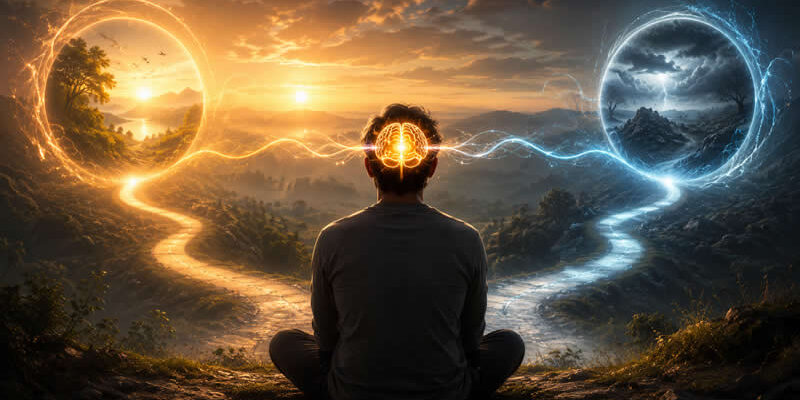
Belief is one of the first inner stages through which a human being accepts or rejects information. Before something becomes a strong conviction, before it begins to control emotions, thoughts, behavior, or life direction, it often first appears as a belief.
In the human brain, belief can be understood as the acceptance of something without complete scientific proof or direct personal verification. A person may believe something because they heard it from someone they trust, because it sounds possible, because it fits their previous experience, or because it gives them hope, fear, or expectation.
Belief is a very broad concept in the human mind. It can open the door to acceptance, but it can also become the first stage of rejection. When new information enters the mind, the brain does not immediately know whether it is true, false, useful, dangerous, or meaningless. It begins to compare that information with memory, experience, education, emotions, and the environment in which the person lives.
This is why belief is often the first filter.
Belief Does Not Always Create Action
Belief does not always have to include strong emotion or immediate action. A person can believe in something passively, without feeling deeply connected to it.
Someone may believe that something is possible, but that belief may not yet create emotion, thought, feeling, or visible behavior. It may remain quiet in the background of the mind. It may exist as an idea, but not yet as a force that changes the person’s life.
This kind of belief does not necessarily influence the real state of the person. It may be present, but weak. It may exist, but without power. It may be accepted intellectually, but not deeply enough to create transformation.
That is why belief alone is not always enough.
The Brain as the Center of Belief
The brain is the part of the human system that evaluates beliefs. It compares new information with everything it already knows or thinks it knows.
Its judgment influences the level of belief and the level of acceptance.
If the brain recognizes something as familiar, possible, or connected to previous experience, it may accept it more easily. If the brain sees something as strange, dangerous, impossible, or contradictory, it may reject it immediately.
This process often happens before a person is fully aware of it.
A human being may think they are choosing freely, but very often the brain is already filtering reality through old beliefs, memories, learned patterns, and previous conclusions.
Beliefs and Convictions Are Not the Same
Beliefs do not usually have the same deep effect on health, life quality, and behavior as convictions do.
A belief can be light, flexible, uncertain, or passive.
A conviction is much stronger. A conviction is a belief that has become deeply rooted. It is no longer only an idea. It becomes part of the person’s inner structure.
A belief says, “This may be true.”
A conviction says, “This is true for me.”
That difference is very important.
When something becomes a conviction, it can begin to shape emotions, decisions, reactions, expectations, and even the way a person experiences health and life. Convictions can become inner laws. They can support a person, but they can also limit them.
When Belief Becomes Expectation
Belief becomes more powerful when it turns into expectation.
When a person believes something and begins to expect a result from it, emotion becomes involved. Hope, fear, doubt, impatience, pressure, and inner tension may appear.
If the expected result does not happen, the belief may begin to change.
At first, the person believed. Then they expected. Then they waited. But if reality did not confirm the belief, disappointment may appear. Negative thoughts may begin. Emotions may become heavier. The mind may start to reject the same possibility in the future.
In that moment, belief can turn into contradiction.
The person may no longer say, “Maybe this is possible.”
They may begin to say, “This does not work.”
Or even, “I will never believe this again.”
This is how an unfulfilled belief can create rejection.
The Fragile Nature of Belief
Belief is fragile because it often stands between ignorance and knowledge.
When a person knows something through direct experience, they no longer need to believe in the same way. Knowledge gives stability. Experience gives certainty.
But belief exists in the space where certainty is missing.
That is why belief can easily move in two directions. It can grow into acceptance, or it can collapse into rejection. It can become stronger through experience, or weaker through disappointment. It can become a conviction, or it can disappear completely.
This is why the human mind must be observed carefully.
Not every belief is truth.
Not every rejection is wisdom.
Not every doubt is intelligence.
Not every expectation is reality.
Conclusion
Belief is the first inner stage through which a human being begins to accept or reject something. It is the brain’s attempt to position new information inside the existing structure of memory, experience, thought, and personal understanding.
Belief may be passive and have little influence on real life. But when belief becomes expectation, it can awaken emotion, thought, hope, fear, and disappointment.
If the belief is confirmed, it may grow stronger.
If the belief is not confirmed, it may turn into contradiction and rejection.
For this reason, belief should not be confused with deep conviction or direct knowledge. Belief is only the beginning of an inner process.
It is the first door.
Through that door, a person may enter acceptance, doubt, rejection, transformation, or a completely new understanding of life.